
Philosophical musings

They Say These Are Just Dreams 

… but dreams may come true. 

How many times have you dreamed of things, impossible in your mind, yet one day they do come true?

Sometimes your dreams seem just like… the mountain summit; too hard to imagine, too far to climb, and too impossible to reach. 

But then, one says, “I have a dream,” while another says, “these are just fussy, meaningless dreams.” The difference between them is that one truly begins climbing the mountain to achieve something, anything, while the other waits down there, laughing, still wondering what a silly, unfathomable dream might be!

For the climber, to reach the summit, to cheer from up there, to enjoy the panoramic view all around from the top, is worth every step, every ache, and every drop of sweat. From now on, there will be no turning back, only moving forward—for every dream can come true.

For the others watching from down there, they wander about with mocking laughter, a few steps, a little effort, and no sweat. Poor them, they can’t see what the climber sees, they will not learn what the climber learns, and they will never understand how dreams can come true.

By the way, don’t you agree that to have a dream doesn’t necessarily mean becoming a president, a royal, or even a scholar? To have a dream is to have a purpose with valuable meaning. In other words, a dream has to do with something that can guide rather than mislead. It is a disaster if selfishness and pride are the sole motivations behind one’s dreams; actually this can be worse than having no dreams at all. 

Do you remember those old days dreams?

As children, we were often asked, “What do you want to be in the future?

Do you remember the boy who said, “I want to be an upright judge.” 

And the other who said, “an honest lawyer.”

And that girl who wanted to be a kind teacher. And another who dreamed of becoming a merciful doctor. 

These little noble dreams often came true, turning into something useful, generous, and prosperous.

Now, please do not to be pessimistic for even amid all the media madness and money mania, these little noble dreams still exist.

There will always be those who surprise us with true, prosperous dreams coming true.

With hope and peace,

Nahla 
Just writing

Please November Be Inspiring 

Today is November the third, and finally I’ve found time to write. Honestly, so far, I have no idea how, or even what, this post will be about. Sometimes there are too many things to say, and other times none at all. It isn’t because you run out of ideas but because you just feel like… maybe later or after this or that. Or, perhaps it was the half-term break, and you wanted to enjoy it fully with family.

So, honestly the only thing that crossed my mind at the very moment was Napoleon. Of all the historical figures, he was the one who crossed my mind. 

Strange, isn’t it? 

I haven’t studied history in ages, and Napoleon, in my history schoolbooks, was an invader, who decided, out of the blue, to conquer the world through Egypt, to spread enlightenment and civilisation. 

But which enlightenment, and which civilisation? 

And who ever said there wasn’t any? 

And who decided that what he offered was better than what existed? 

I have no idea. 

But his project didn’t last long, and as far as I remember, for only three years, and then the whole expedition ended in a big failure.

Does this remind you of something else? 

Anyway, back to November with its dear winter. It has knocked heavily at the door, bringing the first hints of the season with strong gusts, heavy showers, and long, cold nights. Its company seems delighted to linger. This week, and the following week, are all grey and rainy and gusty. But that’s okay, we’re used to it, and we endure the visit with waterproof coats, warm homes, and delicious, hearty meals. Still, with a hopeful heart, I pray November and its dear guest have remembered to bring along some inspiring moments, not with more Napoleons, but with some… blue and white and sunshine thoughts. 

So, please November, be an inspiration of hope and peace, a gift of happiness, and a promise that beautiful dreams may come true.

With hope and peace,

Nahla 
Philosophical musings

I’m sorry

Some people whisper it from the heart,

Some repeat it out of a habit,

some grumble it, 

some murmur it,

and some are too proud to let it slip from their tongue.

Aren’t these expressions of apology obvious to interpret? 

Both your brain and your heart can tell which is which, right? 

You don’t have to study psychology to distinguish a casual, fake, under-the-breath, shy, or sincere apology.

You know who’s the worst of all? 

Those who go round and round to avoid giving an apology;

as if they make no mistakes,

as if they don’t know,

and as if they are superior and above all reprimand.

They will tell you endless stories—fake or true, short or long—

just to evade what, for them, feels like the heaviest and most complicated word on the tongue: sorry.

But, those are hopeless cases. 

Do you know why? 

Because if you argue with them, they will explode.

If you go along and pretend things are okay, they will hurt you more.

The only suitable reaction is to play it safe, and smile not because they’re funny, but because they know you understand them.

Suppose one day someone comes to you with a warm, sincere apology— one touches not only your heart but also your soul.

Would you accept it? 

I think things depends on how close the person is to you. 

And how deeply the deed behind the apology has affected you. 

Right?

One day, as we usually do on special occasions, I sent an old friend a greeting message, and in her respond she asked me to forgive her.

The only harm she caused me was … disappointing me as a good friend— someone who was supposed to be there when I need them.

“I forgive you,” I texted back for I couldn’t find a reason not to.

To be honest, I was thinking more of myself than of her, thinking of how I would like to be forgiven too. 

But… you just can’t feel the same with the person.

Since then, she hasn’t sent any more messages, and neither have I. 

We have this famous saying in Arabic: Forgive and forget.

Funny how I used to teach it to my children, and they would wipe their tears, smile, and hurry outside to play with their friends again. 

But there’s another version of this saying: Forgive, but do not forget. 

The older you get, the more you understand why this version feels wiser.

It’s just a reminder that you, as a human being, need both to forgive and to be cautious.

To forgive is to purify your heart from anger, hatred, and agony, and to find this peace of mind that nourishes your soul.

To forgive is a noble path towards finding forgiveness yourself.

But, you, the same human being, have to learn from the experience.  It’s necessary, somehow, to remember the hurt, the lie, and the deception not as bitterness but as protection. Otherwise you may get hurt or disappointed twice. 

They say if something happens twice, it is more likely to happen again.

Isn’t that true? 

And people … they alway teach us important lessons. 

So grant your forgiveness, but remember why you give it in the first place. 

And, don’t close the door, just leave it a little bit ajar. 

With hope and peace,

Nahla

Just writing

Rain and Sun 

Today, an hour ago, as I was reading by the window, I glanced at the blue sky. Its beautiful blue invites everyone to gaze into it and forget everything else. 

Beautiful, I whispered, and my eyes moved back to my reading. But then, the sun shone into them. I tried to evade its brightness, but couldn’t. It was warm, and we had missed it over the last few days. 

So I remained where I was, enjoying its warmth while continuing to read.

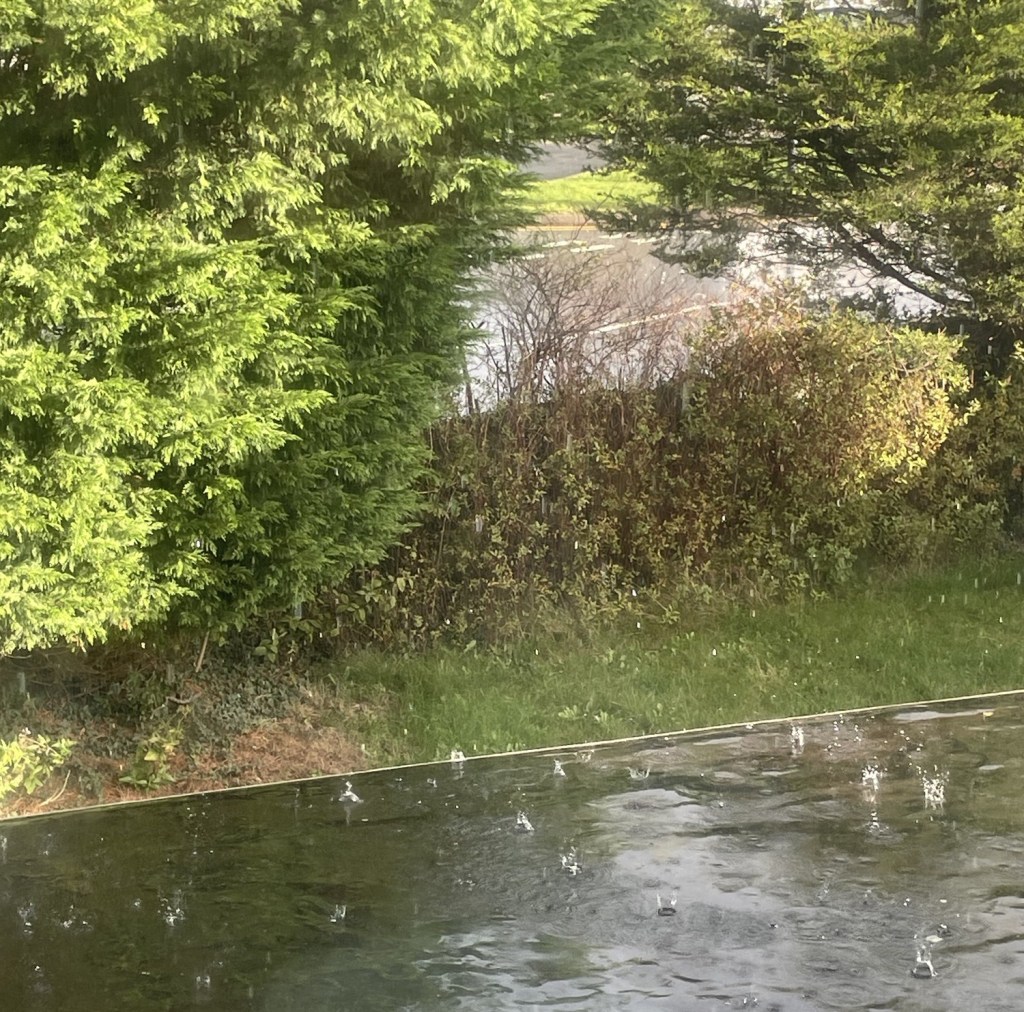
Then, all of a sudden, I heard rain, beating rain, big raindrops falling somewhere. 

I glanced out the window; no rain. But, I did hear rain.

I moved to another window, and just then it was pouring, generously pouring. 

The sun was shining and smiling, happy to watch the rain, just like me.

Oh my… the poor people were running along the streets. It’s been a bit chilly here, but some still think it’s not time for coats. They were running, trying to find any shelter. The trees gave them another cold shower, and the sun began playing her favourite game of hide and seek. 

And I smiled. 

Then the rain stopped, and the sun was still playing.

Oh my…  I remembered the laundry. It wasn’t outdoors, but I wondered whether to take it out or not risk it for my friend still playing hide and seek. 

Better not.

But I hate dryers.

I think I’ll give it a try.

That’s how rain and sun can change your day—from weather to whether.

With hope and peace,

Nahla

Books

Can the life that was right for one be ever right for two? 

“I wondered whether the life that was right for one was ever right for two!”

That’s a quote from My Antonia, which I’ve just finished reading.

Isn’t it true?

It is.

Some people, for example, choose a simple life, feeling happier and more secure in small cities. But, others prefer the busy life in big cities where there are more people, more opportunities, and more entertainment. 

Can these two groups swap places?

Maybe.

But things depend on the urge and the necessity behind the change. In other words, change happens for a reason. You don’t just wake up in the morning and decide to leave your house and move to the mountains… or do you? 

Now imagine how destiny might bring together two people with different life preferences. What do you think their life would be? 

In the story, Antonia’s parents have this acute different preferences, not just about places but about many things. Her father left their homeland, taking his wife and four children to the new land. If it hadn’t been for his nagging wife, he might have never left, would’t have never sold the precious and the worthless to embark on this journey. He couldn’t adapt to prairie life, and his wife never stopped complaining. Then, one day he took his own life. (Oh, the poor man he might have shot himself twice, especially now, when laws are changing.)

But Antonia managed to find a balance, and to help her city -loving husband adapt to prairie life though not quite as much as she did, but enough. And, at least, he never reached the desperate limits her father had.

Now can the life that was right for one ever be right for two? 

Yes.

When there’s love, understanding, and a sense of belonging everything becomes possible. 

By the way My Antonia is just about Antonia. 

With hope and peace,

Nahla 

Philosophical musings

Deep: What Else Can Be Deep?

This is not about seas, oceans, rivers, or any natural or artificial forms of water.

By the way, don’t you agree that artificial rain feels fake in movies, but real in books? Or am I the only one who feels that?

But why wouldn’t you agree? 

Don’t you use your senses more deeply when reading than watching? 

Well, I do. 

Imagine the difference; instead of taking things for granted in a movie, think of how your mind creates a world of its own while reading. It has many functions to perform throughout the reading episode. It reads, listens, talks, colours, breathes, moves, builds, plants, and  does even more creative things. 

Hopefully now you get my point.

Now back to ‘deep’, where else can we use it? 

Well, what just crossed my mind is books, or literary works in general.

Sometimes we say: it was a deep book. This is either because we understand nothing … or because it moves us deeply.

Honestly, if I don’t understand a book, this means I found it dull, obscure, but never deep.

But, may I make a confession? 

One day after reading a book I found it… different, and decided, for the first time, to leave a comment. 

What do you expect I wrote?

“That was a deep book.” 

To this day, I have no idea how I linked ‘deep’ to a story that was, for me, simply different. 

How annoying and embarrassing!

Ever since,  I’ve been thinking twice before using ‘deep’ to describe a book.

Throughout my reading, I’ve found that when a book moves you, it doesn’t necessarily mean crying buckets, dreaming happily at the ending, or grabbing the dictionary to search up most of its terms. 

It’s more about the meanings, the voice, and perhaps the message of the work. The elements that urge you to think, to learn, or to understand things you have’t known before. 

In other words, it not just about reading catchy content, but about drawing lessons from it.   

With hope and peace,

Nahla

Philosophical musings

Master Your Emotions

That’s the title of a book I heard about but haven’t read. And, honestly I don’t think I am interested to read it. 

So why am I talking about it now? 

Simply, it’s title inspired me to write what I am going to share in this post.

And since I have no idea what’s in the book, please don’t mistake this for a review or a critique. You can say… it’s one of my philosophical musings.

Well, mastering your emotions is … a bit complicated process. 

You know why? 

Because things might spiral out of control.

No necessarily because of you but because of the power of stimulation.

So imagine, just imagine, you open the window and see your neighbour wearing this Churchill-cat smile as they offer food to a tired, lost, and hopeless cat. 

You smile, then turn away to look at other things with happy and kind emotions overflowing inside you. 

An hour later, you hear desperate, heartbreaking meows.

You rush back to the window, and there is the neighbour—hitting, kicking, and tormenting the poor cat. 

Why? You wonder. 

You call out to the neighbour, to have some mercy, some kindness, some humanity. 

But no.

She turns deaf ears and blind eyes to whatever you say, beg, or plead.

How would you feel, then?

How can you master your anger and disgust?

Well… that depends.

If you doubt their sanity, or if they show critical symptoms of cruelty, sharp tongues, or… power.

The first tactic might be to avoid them. Once you’ve gotten away, you may pray that hell become their eternal home soon, and with the rest of the devils.

The second tactic might be to pretend that nothing happened, as if the cat has no soul, as if the neighbour were joking, as if it were all fictional. But, since that’s a big lie, the neighbour will laugh at you, at your silence, your weakness, and… your inability to stand up even for a poor cat.

The third tactic might be to open your door to the poor soul; feed it, heel it, and cuddle it. In other words; be the kind, the love, and the human. And, let the neighbour watch, or perhaps laugh, or perhaps burn with anger. 

And, one day, we will all reap the harvest of our own deeds.

Sometimes you can master your emotions, but have you ever wondered why, when, and at what cost? 

With hope and peace,

Nahla

personal thoughts

Flowers Again: Which One to Water?

Here are two flowers.

One fake, and real

Which one to Water?

Really… what a question.

Why?

Because:

Fake flowers don’t know water,

don’t feel water,

don’t need water,

don’t love water.

Give them water.

And then, what?

Nothing changes.

They are still cold,

still dull,

still fake.

With no response,

no life.

But…

Real flowers know water,

feel water,

scream for water,

survive by water,

and love water.

They are warm,

they are soft,

they are beautiful.

They grow,

they bloom,

they lean—

they are full of life.

So … the question is out of the question.

It is unfair.

Whatever is fake can never be authentic, a whatever is authentic will never be fake—never a passing fancy! 

Can this paradox exist in writing?

Yes, even in writing.

They say:

If you’re stuck while writing, then you don’t like what you’re writing. 

Truth.

Force it, and your piece will be cold and dull—just like a fake flower.

And… they also say:

You may write for money, but don’t write just for money.

This makes great sense.

In the first case, your writing still pulses with life. 

You can stare at a rose on a tree, 

describe its rich, natural colours, 

breathe in its beautiful scent, 

watch a butterfly dancing around, 

and then,

 you write an authentic piece,

a real flower,

even if it was for money.

But, in the second case—

when writing is just for money, 

you seek only money in life. 

Then,

a fake flower will do,

a fake voice will do,

fake emotions will do. 

And, a bit later,

the harvest is just … a fake flower,

with no natural beauty, 

no life. 

Have you ever thought of what truly matters to a writer, an emerging writer like me? 

It’s not money,

It’s when talented writers read your piece, like it, and choose to follow you. 

Isn’t that more worthy than money? 

With hope and peace,

Nahla

personal thoughts

Pray For Flowers…

…but don’t be surprised when the Almighty sends rain first.

Success, happiness, peace, health, wealth, and victory are all flowers of a beautiful harvest.

The hardworking, 

the innocent souls, 

the broken hearts, 

the poor victims, 

they all pray.

Day after day,

Month after month.

A year passed.

A second year too.

They wait,

and

wait,

and

wait.

Then, instead of flowers,

God sends rain,

Heavenly rain,

Blessed rain.

To wipe the tears of the mournful,

To relieve the pain of the suffering,

To quench the thirst of the tired,

To wash away ashes,

To nourish the land.

And let flowers blossom,

And Bloom,

again and again.

With hope and peace,

Nahla

personal thoughts

Who will you be?

I came across an interesting question on Instagram, written in Arabic. So here I am, translating and sharing it with you.

When you’re alone and you start talking, who are you— the speaker or the listener? 

Interesting, isn’t it?

It happens quite often that I’m alone at home. My sons have already moved to other cities for work. They are not too far, and usually visit us on the weekends. So when my husband goes to work and my daughter to school, that’s when I am alone. 

But by alone, I don’t mean lonely for my hands are usually full with chores, studies, and other interests that make time pass in the blink of an eye. 

Now do you mind a bit of philosophy today? 

Great.

Here’s my own interpretation of the question. 

When you are alone, wherever you are, with no company but yourself, and you feel like breaking the silence around you, will you speak out loud to yourself or will you listen to it? 

Can you make yourself a case study? 

Imagine it’s all quiet around you as you begin writing your post. In that moment, are you speaking or are you listening? Which one are you doing right now?

But first, before the experiment, can you consider that it’s a bit strange to talk out loud to yourself, especially when you are alone. You might start to doubt your sanity! 

Funny how a memory just crossed my mind that fits with all of this.

Years ago, my father-in-law saw a man walking down the road, talking out loud with no one around. He felt sorry for him, thinking; oh poor man had lost his mind. He couldn’t stop laughing when he knew that the man was using headphones. 

Sometimes, out of anger, happiness, or disappointment, you might burst into a tantrum even when you’re alone. In those moments, speaking to yourself can actually be good for your sanity.

Now back to the question, and the case study.

In my case, before writing, I am the listener. But, as I write, I become the speaker. In other words, before I begin, I mainly listen to things around me, including my own thoughts. Then, when I sit down and decide to write, I break the silence and speak.

Why don’t you write your own interpretation? 

With hope and peace,

Nahla