What traditions have you not kept that your parents had?
I was born and raised in Cairo, Egypt, following a traditional meals routine. I still remember the mouthwatering flavours, the warm gatherings, and the funny moments. But, I no longer follow that routine—not because I don’t want or because I can’t. It’s simply because it just slipped out of my days as the years went on and on.
So, back then in Egypt, we used to have three meals a day: breakfast, dinner, and supper. But, of course, there were lots of snacks and desserts in between. Not to mention the roasted peanuts and pumpkin seeds during those long summer nights—whether out in the balcony or inside as we gathered around the television.
Our breakfast and supper were usually light and simple: tea, milk, and a cheese or jam sandwich made with fresh bread straight from the bakery.
Breakfast usually started early, around six or seven in the morning, since everything else began early too. We’d eat in a hurry so we wouldn’t be late for school, university, or work. Then, we had another full breakfast around ten during the mid-morning recess. Supper was usually by eight or nine at night.
Dinner was the main meal with traditional Egyptian dishes. We always had it by half past three when the whole family was home—father back from work and children from school. Back then, my family never dined out or ordered in. But of course, we did have dinners with relatives and friends — especially during the holidays.
When I moved with my husband to the UK, that traditional routine changed, not immediately, but gradually. So, instead of the two breakfasts, we have just one. Then we were introduced to lunch at noon, followed by the late afternoon dinner that kicked out supper from our routine. Still, we remained faithful to having snacks and desserts in between.
Now, food is another story in my break from the traditional meal routine— please understand that was entirely unintentional. It began with cornflakes and toast, which (thanks to my children) became part and parcel of our daily life, just as essential as water and air. Praise the Lord, they no longer crave any.
I love cooking and baking—and, of course, I love Egyptian food. But… though our dinners are usually home –made, we dine out every now and then. Besides, our traditional food is not one hundred percent traditional. Perhaps because the food and flavours are not the same. But, that’s also because I’ve started creating new meals, following my own simple recipes.
Thank God, my food, in most cases, turns out delicious, and my family devours it all.
When it comes to food, there’s some sort of flexibility to change your traditional routine.
But I can’t. I have to take off something, add something, or change something. Don’t they say you should have your own signature? I totally agree.
Honestly, it’s interesting to watch how others use measuring cups, measuring spoons, a special knife for a special job, etc — so neat and accurate. But some people do not feel comfortable, and cannot work efficiently this way. Some people mainly save the main ingredients, omit the extras, and play without measurements. It’s easier, more fun, and feels special this way. If you relate in this context, then you should have heard of the traditional, old fashioned kitchen club. It’s different from today’s kitchen, with its sophisticated equipment, countless ingredients, and artificial colours and flavours.
By the way, you can count me as a member of this Traditional Kitchen Club. Would you like to join? While thinking, let me explain a few points.
When joining this club, you need to be both patient and smart. There will be moments when you face problems and can’t evade embarrassment. Here are some extracts from my no-fixed measurements experience.
Say, for example, you have guests, and they praise and applaud your hospitality. But then, things don’t stop at liking and praising, for they become intrigued to know your unique recipe, and perhaps save it. Here’s my reaction as a member of the club:
‘The ingredients are ….’ I list them and pause for there is nothing else to add. I don’t have specific measurements. ‘hmm, you know… sometimes measurements vary, depending on personal preferences.’ I explain with a smile.
Now, remember that these occasional visits with guests are much easier than your everyday interactions with your family. You should thank God that you don’t have guests everyday, do you? Here’s some snaps of my everyday experience that you might expect from your family in case you decide to join this club.
Whenever my daughter helps me in the kitchen, she asks the usual questions: ‘how many spoons to add?’ Big or small? Which cup? How long to stir? How long to wait?’ Now she’s the aprentice, and I am the chef, and to make things easy for both of us, I have to estimate. But honestly, my estimations, most of the time, make things taste a bit different — or sometimes entirely different.
And there’s another challenge with my sons. They rely on their own measurements, but they don’t stop asking questions: “Which is which?” “Where is that?” “Can’t find it.” “Please put labels on things, mama.’ I finally did, though as a member of the Traditional Kitchen Club, I am convinced that your sense of smell is all you need to find what’s required for the recipe.
Now it’s tea time – traditional black or green tea. But according to the club, adding herbs to tea is beneficial, so I add some: mainly mint, cardamom, rosemary, or somtimes, thyme which tastes great with tea. (I add one at a time – in case you’re thinking of following the recipe). But, you have to expect that your spouse will miss the familiar taste and ask for a cup of plain tea.
And finally, in this club, while there are no fixed measurements, and freedom is granted, there’s one simple rule to remember: be yourself in your kitchen, and if you prefer simplicity, natural ingredients and warm flavours, then you’re more than welcome, and the Traditional Kitchen Club is waiting you aboard.
With hope and peace,
Nahla
P.S. I was so hungry today – It’s the 28th of Ramadan. Perhaps that’s what inspired me to write this post.
Or baklava? Both are correct – the first is in Arabic, and the second in Turkish.
You can buy it from the shops or restaurants, or make it at home. I love to make it. It’s the simplest recipe ever: puff pastry sheets, ground nuts, butter, and syrup. There are millions of videos on YouTube for this simple dessert.
Baklawa is most famous and enjoyed during the month of fasting; Ramadan – our very special, once – a -year guest.
Are your mouth watering already? Mine is.
Sometimes, you might think, like me, that you can transform your traditional dessert recipe into a healthier one. Here’s my experiment with baklawa last year, and my baklawa this year.
Last Ramadan, I decided to cut all fine sugar and use honey, dates, or fruits in all desserts, including baklawa. It wasn’t because I was on a diet or had any medical issues, but because I want to eat healthily. So, the only change I made to baklawa was to replace the sugar with honey. But honey is thick and has a different taste, yet I insisted on using it.
“Where is the sugar, mama?” “Why does it taste weird?” “Is there any other dessert?”
My family compalined, obviously didn’t like it, and neither did I. It wasn’t making your mouth-water but rather make it shut and dry.
Therefore, for this Ramadan, I’m making it the normal way with homemade sugar syrup. Now, that’s the mouth-watering baklawa with layers of pastry sheets full of ground pistachios, walnuts, and almond. On top of each crispy piece, the shiny syrup spreads smoothly and penterates deeply into each layer. One bite of baklawa with its dripping syrup would make it ready to fast for the whole year!
Have you tried fasting before? I’m just wondering how you feel about it?
Do you or your family make any special dishes for the holidays?
We often hear that men do not know how to cook, or even worse, their cooking is terrible, don’t we?
But isn’t it strange when you find out that they can, or can do very well.
Cooking is mostly one of everyday mandatory chores, but it can also be fun and a special hobby.
I still remember my father’s baked potatoes with meat. Although he mainly used basic spices, that dish was like nothing else- delicious. I remember he used to cook this dish, mainly, but not often, during the summar holidays. The aroma would waft through our house, making our mouth water. I remember how he looked so proud and happy of his achievement.
Strange how simple things, such as baked potatos with meat, can be carved in children’s memories. And, how strange that some parents deny their children such beautiful moments to relish later on when they grow up.
If it weren’t for the speciality of the chef, the love it was made with, and my family around it, I am sure that dish wouldn’t have crossed my mind for today’s prompt.
Hello everyone. It’s been ages since I posted anything, but sometimes one gets busy with other things or a bit lazy.
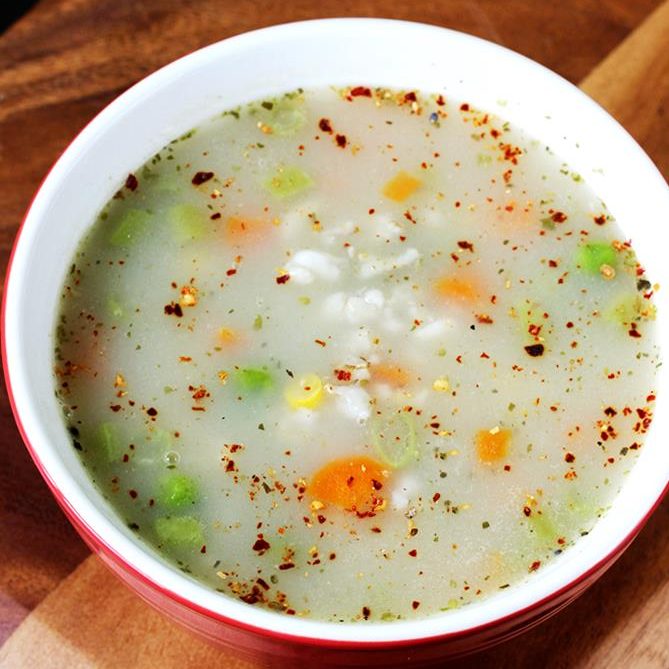
Today it’s about my oat soup. It wasn’t my recipe, to be honest; I watched a Youtuber cooking it and decided to try. It’s good to try but not so much when you’re fasting. But, why not?
These days we are fasting the month of Ramadan. We usually break our fasting with dates, water or juice. Then we started with soup. By the way my boys sometimes ( or always) didn’t follow the same order, and started with the main course.
Ah, back to the oat soup, it looks delicious on Youtube but turned into a totally different thing on our dining table at Iftar time. Untouched. All the soup was poured back into the pan, and today I’m waiting to see if the birds in the garden will have a different view.
Do you like Oat soup?
Wishing you all the best,
Nahla
PS the photo is of course not mine. It’s on google, but maybe next time, next year, mine will be yummy.
Eid is expected to be tomorrow. This means the month of Ramadan is 29 days this year. Yesterday, while we were having Iftar, my son said; ” Ramadan has gone so fast this year.” I thought I was the only one to notice that but we all did. Really the month has gone so fast. I cannot believe that 28 days ago, I wrote about my plan to post every day during this month. I tried but I couldn’t. Anyway, I’m happy I’ve started writing more posts than before.
I mentioned in one of my posts that I was determined to make no experiments; no new recipes to try. I kept my word. However, there was a tiny problem; I usually forgot if I added salt or not and I cannot taste the food; I’m fasting. If there wasn’t enough salt, we would add some, no problem though the food wouldn’t taste as nice. The major problem happened when I added too much and it did happen, a couple of times. One of them when we have guests but their hands didn’t reach that plate. Thanks God, I prayed and wanted to take it away before they would think about it.
By the way, I didn’t cook the food in this photo. It was on my son’s birthday and we had our iftar out that night. It was Yummy Yummy.
Children has a wild imagination which is really nice, good and interesting but sometimes this imagination, instead of being fun, turns your day or may be your week upside down. Here comes the problem!
One day, my daughter’s friend told her that a bone was stuck in her throat and she went to see her doctor, he got it out and she was fine, playing and happy; a simple tale (may be made up by her friend), but it wasn’t so for my daughter; she listened and imagined the process, stored the details in her brain for later which was not that far.
She imagined everything, she ate or would eat, would be stuck in her throat, vegetables in her soup, mashed potato, everything soft or hard; how long I explained and how she listened carefully was good, really good, at least her panic was a bit relieved and she would eat little and go to play, but soon she would come back, crying, repeating the whole story.
Finally I explained how her body is very clever; there is a liquid inside her mouth (is it Saliva? I think so) helps her sharp teeth mash and ground all of what she eats, some water or juice will do a great job to also help her strong tongue swallow and push everything through her throat straight away into her stomach. And it works.
‘Of course nothing could ever be stuck in my throat,’ she boasted.
Yesterday I read a couple of interesting posts about food which inspired me to join the club and write something about the same topic but in different way.
Sometimes parents force their children to eat certain food even if those little ones’ tears run down their innocent faces asking for mercy not to eat it. But we ‘parents’ believe that if we don’t do that we won’t be good parents and we won’t be caring that much about our beloved children. We also wonder if we like that food, how come they don’t like it? We think if it’s important and healthy for our bodies, they have to eat it. And we keep thinking a lot ignoring the fact that the child might get all that benefits from another source of food, something they like its taste and smell.
My older son doesn’t like mango at all and hates its smell; I really couldn’t understand how come he wouldn’t like this juicy sweetie fruit which I adored? One day I forced him to eat a tiny bit just to know its taste hoping he might change his mind. But this was the worst idea ever because he felt sick and was very upset. What was for me juicy and sweetie was for him slimy and gross, it was as if all his senses hated it and refused to welcome any of its nutrients to get inside his body. But at that day, I wondered why I forced him in the first place especially as I had similar experience with another kind of food?
When I was little; I didn’t like the smell of cooked liver; it made me feel sick and I would definitely never taste it. The day we had cooked liver for dinner was my worst day ever as everything would smell liver: bread, rice, salad, plates, spoons, towels, etc. I don’t remember that my parents had forced me to eat it, but my mother used to make some tricks like changing the way she cooked it or giving her dish a new name. But I would always find out the truth even before tasting the meal as its smell is so distinguishable; something that could never be concealed. When getting older, I learned about the function of liver in science class and I really felt grateful that I had never tasted it. Honestly, I have never cooked liver in my house for my husband and children and I don’t know how to buy it. But they do eat it at their grandparents’ house; just little portions and I would never ask them to have more.
I know different stories about people of different age group who don’t like other kinds of food, for example: milk, fish, cheese, tomatoes, etc but this doesn’t mean that it’s the food being tasted is itself bad or horrible. It’s just something inside our bodies that do not accept that food. There are taste preferences and aversions and there should be a space for letting others make their own choice as what you adore, others might abhor!








 Pure and Simple