What aspects of your cultural heritage are you most proud of or interested in?
The first thing that struck me as I read today’s prompt was something I truly like about Egyptians, something that can be a special trait or a characteristic that most of the Egyptians are known for. And you know what? Even after living abroad for so many years, I think I still have a bit of it.
Can you guess what it is?
It’s how they carry humour in their talk, how they simply crack jokes in passing comments, how they can lighten what is heavy and simplify what is complicated. To put it simply: how naturally most of the Egyptians can be both funny and witty.
They love to laugh, to spark laughter, and to cherish every laughing memory.
“Why aren’t you laughing? Afraid your skin might crack?” That’s how they react when visiting with someone a bit too serious
It’s always funny when we meet up with Egyptian friends and they try to joke with my children. My children smile which is a clear indication that they did’t get the joke. I stifle my laughter. I cough. I breathe. And then our friends repeat the joke.
My children turn to me: their faces wondering what’s so funny, and their eyes pleading for a quick explanation. I burst out laughing, not at the joke but at their reaction. And then they burst out laughing not at the joke but because laugher is contagious, just like yawning.
And this is one of the most well-known Egyptian sayings about laugher:
“Just laugh, no one’s taking anything from this world when they leave it.”
As far as I can remember I haven’t known anyone with a birthday in April. The calendar has at least one birthday marked on every month ‐ except April. Not that it makes much of a difference, but the thought just crossed my mind. Perhaps, one of you reading this post is celebrating a birthday this month?
But it’s a beautiful, springy month. When it arrives, it announces the beginning of long days and short nights. What’s more, it relieves us from the long month of March. Have you ever noticed how those thirty-one days of March feel like the slowest in the entire calendar? Perhaps, It’s just me feeling that, but they really crawl at a turtle’s pace.
Have you ever heard about the Nile Bride? In case you haven’t, here’s the story.
Once upon a time and in a special April day, during the Pharaonic era, the Ancient Egyptians decided to offer a maiden bride as a sacrifice bride to the Nile. They believed this act would make the river flow all over the year and bring abundant harvests.
The bride was chosen at a young age. The status of her family was important, and so was her record of medical health. And, of course, she had to learn swimming. After all, it would be a shame, if history said that the Ancient Egyptians who built the great pyramids used to sacrifice a bride who couldn’t swim on the Nile’s alter. Besides, the Nile would expect a beautiful bride not a corpse. Therefore, the Great King would deliver a memorable speech at the ceremony, clearing up any misconceptions or alterations about the sacred rules that might emerge in the future.
‘The Nile isn’t an artificial lake or a small muddy pond. It is the lifeblood of Egypt,’ boasts the king. ‘Our Nile deserves the best, and his bride shall be our queen for an entire year.” The king voice reverberates, and the crowd cheers. ‘This gold crown with all its diamonds and holy stones is your dowry, our Nile Bride, our queen.’ The king places tge crown on the bride’s head, offering her his blessing.
‘And if you don’t survive, our Nile will still be pleased, for the dowry will return to its holy source,’ the king declared, his gaze fixed on the bride. ‘Now you have two wishes; one to be gratnted if you return safe and sound, and one to be fulfilled if you don’t.’
Silence enveloped the entire scene. The crowd stood tall, strong, and mute like granite statues. The birds hid among the trees. The horses grazed here and there, moving as quietly and slowly as old turtles. The only sound that made the scene live was the river’s flow – elegant, smooth, and shimmering.
The bride, in her white Pharaonic dress embroidered with blue, red, oranges, and yellow jewellery across the chest, felt a terrible headache. The crown on her head weighted as if it were ten tons, making it too difficult to think and impossible to make any wishes. She felt the blood in her small head trapped and squeezed inside her veins. For a moment or two, only two wishes lingered in her mind, and were on the tip of her tongue, ready to escape her lips, if she hadn’t sealedthem shut just in time. For the wish she’d make if she survived, she wanted so much to push the king into the river, wearing the same crown to see whether he would make it out alive. And for her wish if she didn’t survive, she prayed the king would have the honour of diving into the sacred river himself to retrieve the holy crown without any blessings, without assistance.
The bride glanced at the king, but his stern, hard gaze warned her that she was running out of time, and he was on the verge of losing his patience. Did he read her mind? She swallowed hard and forced a smile.
”I have no wishes, Your Highness, other than to wish you a prosperous afterlife in the great pyramid,’ she replied and jumped into the river.
The bride survived and the king was buried in the great pyramid.
Of course, this story is purely fictional — I made it all up. You can think of it as one of April Fool’s Day pranks. And, to be more honest, I have no idea if the legend of the Nile Bride is related to the month of April.
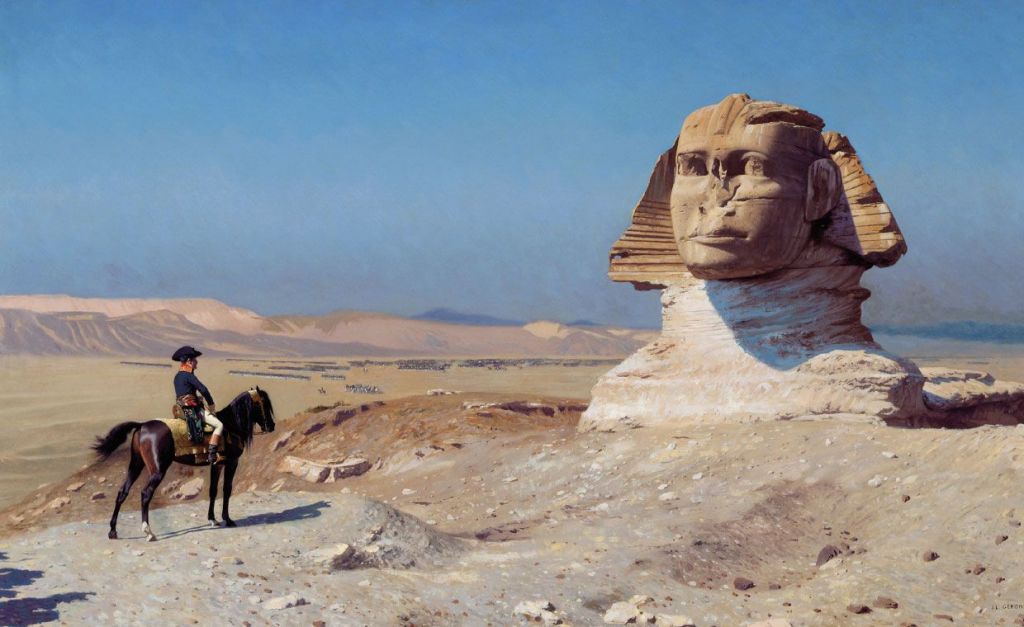
In Egypt until the sixties, the French language was common in Cairo and Alexandia. This Franco – Egyptian influence stared with Napoleon Bonaparte’s invasion of Egypt at the end of the eighteenth century. Though the expedition was a big failure and didn’t last long, mainly three years, it had affected the culture, including the language, mainly among the elite, literary, commerce, and political classes. Since then, French seeped into the Egyptian Arabic, though with some alterations and accent.
In our daily language, some French words easily slip off our tongues. Here are some examples: douche (shower), couverte ( blanket), pantalon (trousers), écharpe (scarf), etiquette, Garçon (waiter), and merci. The list, of course, is too long to mention all.
One might wonder how such change took place, if Napoleon’s expedition didn’t last long and was mainly limited to Cairo and Alexandria? That was mainly because of education. French missionary schools, mainly for Christians and Jews, were introduced in the main cities. But, later, they were open to Musilm Egyptians as well, and french scholarships were granted to Egyptian students. Scientists, politicians, and businessmen, became well acquintted with French systems and law. And then, as historians put it in our history books, modernisation found its way to Egypt.
Thanks to the word “automobile,” that this post turned out a bit historical. But isn’t it better this way?
I have but a long time ago. My boys went there once but I’m sure they would not remember that trip because they were so young but my daughter hasn’t yet.
A long time ago, going to the pyramids was one of the main school trips and of course, it was always during the winter. They are beautiful; three pyramids; stand together not far or so close. The stones used in the building are amazing; they were collected or cut from a quarry, transported in boats sailing over the Nile, pushed over the dampened sand in huge sledges which were dragged by horses, camels and well-fed builders. At last, those stones were hauled through ramps over ramps over ramps until the building was done. How those ramps were exactly constructed is still one of the ancient Egyptian mysteries!
Do you think the Pharaohs had built these Pyramids to be one of the seven world wonders? Or to enter Guinness World records? Definitely NO.
These pyramids were built to be tombs; sacred, powerful and maybe cursed too. The Pharaohs believed in immortality. Their corpses and food were mummified. Their jewellery, money and other special items were locked in their tombs too. Their Statues were sculpted and placed in magnificent temples. Paintings of their images and life were carved on the walls of tombs and temples. Why did they think of those complicated procedures? They did all that because they believed in life after death. They believed their souls would come back to their dead bodies and they would rule and live but in a different way; not as a supreme ruler but as a god. This is why the heart was the only organ to be left in the dead body. This is also why they locked all their valuable and precious things in their tombs. It is also said that Pharaohs cast special spells to protect their tombs.
I don’t like to get inside the pyramids; so dark and humid; besides it is not well ventilated especially with so many people. And the most important thing is not to get the Pharaoh’s curse (joking). This was many years ago; maybe things inside have changed.



 Pure and Simple