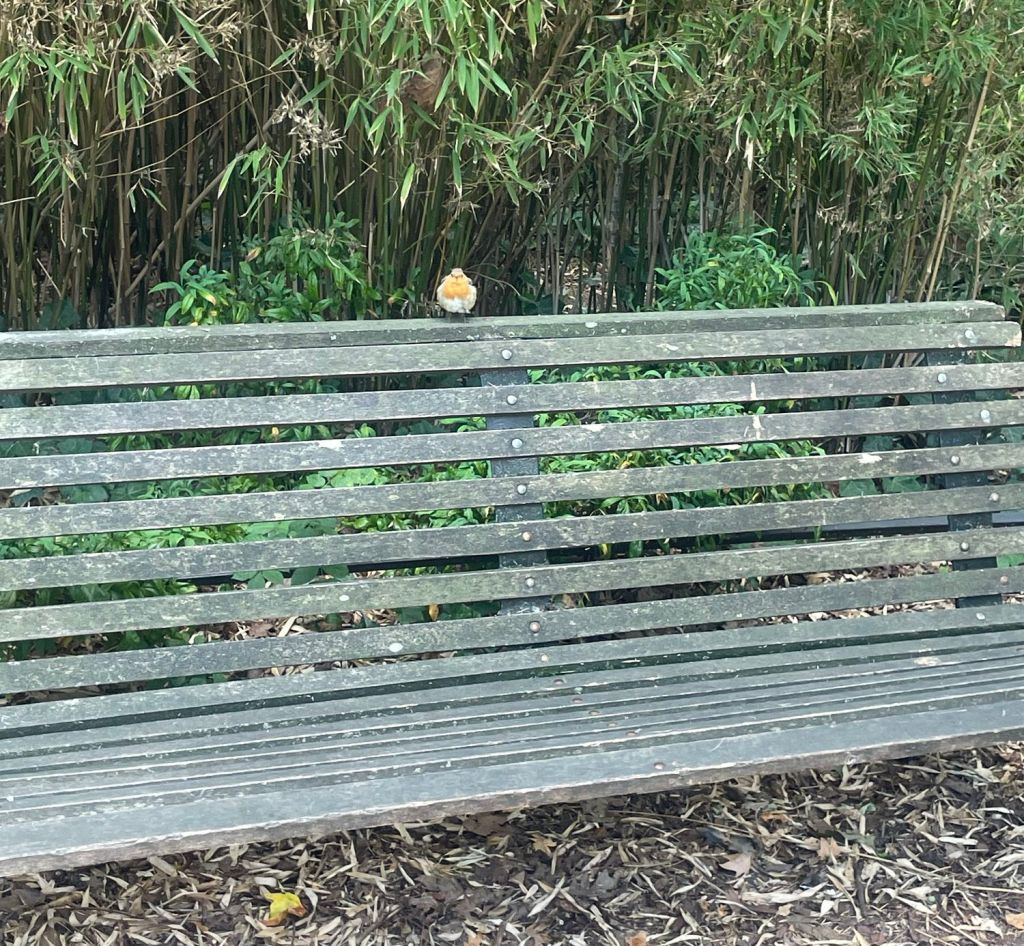
He was standing just like that— perched on the back of the rusty bench while my daughter and I were walking in the park. She saw him first and whispered to me, “Look, Mama, look at that robin.”
“Oh, so cute,” I whispered back, and we both froze on the spot— wondering whether to move closer or walk away.
We quietly moved closer, and—surprisingly— the noble prince remained on his throne. Whether it was humility or pride— he stayed silent, his tiny eyes seemed to watch us.
How I wished he would sing— something, anything. But he seemed to have no song. Still, we couldn’t blame him; it was such a grey, humid, and hot day.
At least we were honoured to capture a photo of the park’s noble prince.
It has been scorching and dry for more than two weeks across the UK. We had been waiting for summer to grace us with its warmth once more— it does, with more than enough. But it seems that rain’s patience has worn thin. Rains have already started gathering mountains of grey clouds, ready to have full control over English weather again.
But that’s normal—I mean the summer’s heat wave and its rain-showers successor. What isn’t normal is the maddness wave that seems to be spreading like weeds all over the world. It seems to be having the worst influence on people’s mentality— from the most powerful to the common, the wealthiest to the poorest, the highly educated to basic learners.
Sometimes, one wonders whether the heatwave is behind the phenomenon of the maddness wave that’s been eating humans’ brains. Probably. But unfortunately, it seems that rains can not find their way to some people—just like Mr. Mad.
Have you ever heard the story of Mr. Mad?
Well, it’s a long fictional tale that began on one of those boiling days. It’s basically about a wealthy great- grandfather living on the top floor of a skyscraper somewhere in the world, who decided to take charge of the whole building—apartments and residents—from the hightest floors to the basement.
Well… I usually don’t give any spoilers in my reviews, but I will just say that Mr. Mad’s days bring the worst heat waves and know no rain at all.
Why do I head there straightaway, on time, to keep my word?
Now it hurts, no… it’s so painful, more painful than the ache I felt before making that decision.
“You’re doing well,” they encouraged
“Well done,” they praised.
“All done,” they congratulated.
And there it is—your wisdom tooth, resting on the dentist’s super hygienic tray, glaring and laughing at you: “Farewell my friend, but don’t blame me for the extra, obnoxious pain you’ll be getting today.”
It’s not wise to extract your wisdom tooth, is it?
After all, wisdom doesn’t only cost a fortune, but it also has deep, stubborn roots that are too painful to yield.
I’d love for eternity if I ever got into one. But even if you gave me a fortune—I wouldn’t.
Just magine getting into a car without a driver—yet everything works perfectly. You hold your breath for a few moments, wondering if you’re travelling to space? The vehicle is luxurious, comfortable, and incrediably smooth. You can’t believe it’s already gliding down the road. Before you know it, you’ve arrived at your destination. You get off and walk away, wondering if it was just a dream.
Perhaps the driver’s seat wasn’t empty after all. Perhaps it wasn’t just air filling the space. Could there have been a driver wearing Harry Potter’s invisible cloak? May be, you thought for anything is possible nowadays, right?
Some people might see that as a great emerging tech idea for safety— a smoother, quicker kind of public service. Wow. They argue that this invention could reduce crime, accidents, and other unethical issues. But so far, many of these revolutionary technologies have been causing more chaos, more moral, physical, and psychological problems like ever before.
Have you ever thought about how these utopian endeavours could affect our senility, our intelligence, our social and emotional abilities, our self-esteem, and our sense of existence. Are these qualities worth nothing?
There’re loads … millions … and more faults in human beings than one can imagine, but at least we are visible, we are real, and we exist in abundance.
Unemployment and homelessness are major problems everywhere—so why make things worse by cutting more jobs, more wages, and more lives?
And then, they talk about some imaginary heaven with high rate levels of stupidity, violence, and poverty.
“Imagine the silence if people only said things they knew.”
I have just come across this quote.
But isn’t it beautiful?
Not everything reaching our ears is worth telling, right?
Oh, and … perhaps you can also imagine, beside the silence, the respect and peace that would prevail if people not only said but also did the things they knew to be proper and fair.
Two weeks ago, or three, during the weekend, we found an unopened board game, a forgotten gift my daughter had received two years ago. So, we decided to play and have some fun without technology.
After dinner, we gathered around the dining table, and started reading the instructions. The rules were a bit complicated with unnecessary details. Rather than wasting time squinting at the tiny print in the catalogue, that needs a magnifier, we decided to make our own rules, instead.
Basically, it’s a word game where players have to describe a certain word aloud—without using any of its most familiar describitive terms.
So, if school, for example, is the word on your card, it will come with a list of some restircted terms—like primary, secondary, education, and teachers. Then, you give a brief description of the word. Other players can ask questions and you answer, avoiding any from the restricted list. The quickest to correctly guess the word, wins the round and gets the card. In the end, the player with the most cards is the winer.
Now, pretend I’m picking a card, reading the word, and having a quick glance at its not-allowed-to use list .
Would you like to play?
Here’s my description;
It’s a divine concept that humans believe and seek, yet most of the time, struggle to apply and fulfill.
Have you ever chosen to remain silent instead of speaking?
I do—most of the time.
Should I begin with critical moments or casual ones? Hmm, I think it would be better to start with the annoying moments then climb step by step toward the pleasant—or perhaps even funny—ones.
It happens when someone asks you for a favour or makes a request, but you have your reasons for not getting involoved. You explain things once, yet they hear nothing but their own voice. Not to mention the blame they put on you, as if you were part of their problem.
Just tell me—what’s the point of arguing with someone who will never be convinced, never change their mind? By the way this isn’t about stubbornness but egotism—the I’m always right mindset. Isn’t silence better than arguing back in such cases? But, of course, you can enclose some genuine prayers, hoping things will be fine soon.
Are you still climbing the long staircase?
Sure, by now, you must feel heavy and exhaused. I imagine you’ve already climbed most of the steps—apparently we experience lots of these critical situations in our lives— each one adding to a heavy load of annoying momories.
Now it’s time to switch to some pleasant moments. I guess there’re only a few steps before you reach the top step.
Sometimes, as you’re hurrying down the road, someone looks, smiles, and waves at you with a bundle of flyers and brochures in their hands. They step into your path and ask for a a few spare moments of your time. Silence becomes your escape, and a nod with a smile— along with a quick gesture to your watch—is your way of communicating apologies, if you, like me, are not interested.
And sometimes, as part of socialising, you find youself among people talking about things you’ve never read about or even heard of—like dog food and breeds. Doesn’t it make sense to remain silent? To listen, but not really listen while thinking of cute cats.
And then there’s silence—a warm gesture of respect for elders. How many times did the younger you remain silent while your grandparents or parents talk about things you could neither understand nor follow? But, they always knew you were not listening. And that’s when your sudden, genuine laughter broke the silence.
Last but not least, there’s is silence and shyness— not only do they rhyme but they are also born together. Yet, that’s not as bad as you might think, because it’s neither a birthmark nor a curse. Can we simply call it a special personal trait?
Some talk loudly and nonstop, and some listen, whisper, and weave stories in their minds.
I think by now you’ve arrived safe and sound , and hopefully happy at the top step.
They say whoever invented the window was either a thief or a lover.
What do you think?
Isn’t it facinating to imagine the story behind the invention of windows for houses? A story not related to construction or decoration, but to a person who, once upon a time, was dreaming—seeking something or someone.
Would you like to hear his story? Just keep reading.
Once upon a time, a thief sneaked into an old merchant’s house. He grabbed every piece of gold and silver from each room. The treasure was not much, but enough. As he turned and grasped the handle of the big metal door, he discovered, to his shock and misfortune, that the door was locked—utterly locked—as if it were a secret, magical guradian of the house
The thief knew the merchant was on a short trip to bring his family back home. But, perhaps, someone would come and check on the house, he thought, glancing around, trying to find a way out.
He noticed deep cracks and dampness spreading across the walls. He drew near to the wall next to the door, and pressed his hand against it—it was mushy, like wet mud. The thief laughed, relieved to find his excape. Without hesitation or much toil, he broke a hole in the wall and jumped out of the old house.
He raced against the wind under the starless sky, heading toward the dark woods where no other human dared to live. Panting, he reached a gigantic tree—his camouflage home. He dug a deep hole and hid the treasure beneath it. Breathless and sweating, he threw his weight onto the hard earth and fell asleep for the rest of the night.
With the first light of dawn, as the birds chirped and left their nests, the thief jumped to his feet and hurried to the nearest pond. He washed and put on a clean garment. Laughing, he picked some berries from the trees, devoured them, and headed back to the city. From now on, he would live a new life as an honourable man.
The market was buzzing with one story—the robbery of the merchant’s house. The thief drew closer to a group of men and introduced himself as another victim of the same thief.
‘But I can fix the wall. I am a builder, and I need money to go back to my city.’ He had woven a good story, hadn’the?
The men took him to the old merchant, who—without a second thought, agreed to the poor builder’s deal.
Over the following days, the thief transformed the hole in the wall into a beautiful, wooden window. The merchant’s oldest daughter loved the new creation and often sneaked behind it to catch a glimpse of the builder as he made windows for other houses.
The builder became well-acquainted with most of the people in the city. His window-making business flourished, and he earned a lot of money. He was aware of the merchant’s daughter’s long waits behind the window, watching him working around. He also knew of her father’s abundant wealth. The girl was beautiful—so beautiful— but he had robbed her father. What if the merchant discovered the truth one day? He fell asleep with that thought echoing in his ears.
That night, he had a dream—a strange dream.
He was in a different land, among different people, surrounded by beautiful houses with so many windows. As he walked along, he heard people talking about the two lovers who had just died. Curious, he moved closer to two men sitting on a bench by a fountain in the middle of the road. They didn’t seem to notice him. Was he invisible? A ghost? His heart pounded hard in his chest as he dropped onto the other end of the bench.
‘Romeo killed himself, and Juliet followed suit. Or was it the other way round? One of the two men broke the news. The other gasped, and the thief felt his heart in his throat.
‘I used to see them every day, laughing and singing to each other. She shone like a blooming rose in the big window, and he stood below in the garden, full of pride, crowing day and night like a young rooster.’ The first man said, the other sighed, and the thief nearly fainted.
‘But of course, her father would’ve never let her marry one of his family’s enemies— someone who was only after his wealth and money,’ the first man explained, the second nodded, and the thief died
‘Oh no, oh no, I don’t want to marry her,’ the thief screamed and woke up.
The next day, he packed, thanked his host, dug up his treasure, and fled for his life.
Years later, the wise said that true love comes from front doors, not windows. If only those wise ones had known more, they would have added and neither does it come from social media!
We’ve had a wonderful, sunny, warm weather over the last three or four weeks? Can you believe it in the UK? It really did happen! Miraculous isn’t it? That was so encouraging to get out and enjoy long walks under the blue, shining sky.
May always brings special, unique surprises, which relate so much to the auxiliary verb ‘may.’ Both are full of possibilities, wishes, and sometimes permissions. Was the month named after the verb? I don’t know—Do you?
Do you like May? It’s okay if you may not.
I love May because it’s usually warm, colourful, and bright, but it may suprise you with heavy showers— just as the forecast expects next week.
Trees and flowers smile at May. They bloom and blossom, sing and dance, and pray: May our winter be far away!
Insects, too welcome the warmth of May. They explore freely around, but they never use ‘may‘ to sneak or rush into one’s house.
Time flies not at a airplane’s speed but like that of space rocket. And here’s May, almost gone. And you, just like me, still hoping … thinking … praying that good news may come in abundance.
May the rest of May be kind and reassuring to all of us.
Don’t they say: “Profound wisdom comes out of babes.” And I think some add “from the invalid too.” I’m sure you heard this quote one day—perhaps also experienced it. So, I’m not going to explain it … actually, I didn’t think about explaining it. I just thought of something different, but not different.
Am I a bit confusing? I think I am, but just keep on reading. Please.
Have you ever thought that wisdom doesn’t imply knowledge? They might meet each other at some point along the life journey, but this doesn’t mean they have to be companions.
A simple person might be as wise as a scholar is scientific. Their paths might cross, but that doesn’t mean they have to be good friends.
Knowledge is all about learning, studying, and creating abstract and complicated words and concepts in various subjects, right? But wisdom is purely innate, flowing from the heart with simple words and deep significance.
A scientist, for example, based on his astronomical studies, mathematical equations and scientific formulas may say: the Earth’s lifespan is almost over, and we need to build more spaceships and start planning to build a new world on a different planet.
Watching the scientist on the news, a simple man with basic qualifications, innate goodness and genuine faith smiles and replies: Aren’t they all the same creation? When our world is done, there will be no life elsewhere.
Transparency and wisdom are close friends—part and parcel of one another. Do you know why? Because transparency loves light, openness and honesty—the same qualities that define a wise person. No wonder both have become so rare that, nowadays, when we hear the tales of the wise man, we only think of our ancient ancestors— from the very, very, distant past.




 Pure and Simple